


Digital Sales Rooms (DSRs) used to be little more than glorified folders: a link a rep sent over with a deck, a proposal PDF, and maybe a video buried somewhere in the mix.
In 2026, that model is effectively dead. The category has split into two camps: legacy tools with AI features bolted on after the fact, and a new generation of AI-native platforms built from the ground up to run the sales room for you.
The difference shows the moment a call ends. Legacy tools still expect a rep to open a blank template, drag in a proposal, embed a video, and update a milestone tracker by hand. AI-native platforms skip all of that. They listen to the call, pull out the business case and next steps, and spin up a fully branded buyer’s workspace before the rep finishes typing post-call notes.
What Makes a Digital Sales Room “AI-Native” in 2026?
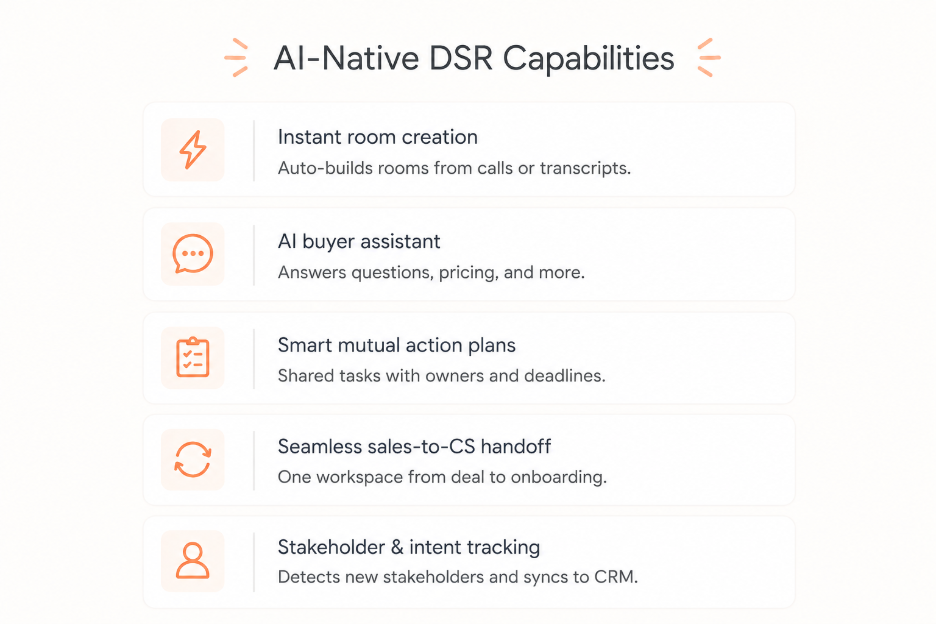
- Instant, zero-setup room generation: The room builds itself directly from call recordings or transcripts, with no manual assembly required.
- Two-way AI interaction: Buyers aren’t just viewing static content anymore; they can chat with an embedded assistant to ask questions, run pricing scenarios, or pull up a case study on their own.
- Dynamic mutual action plans (MAPs): Shared, deadline-aware checklists that turn the deal into a joint project rather than a one-sided pitch.
- Lifecycle continuity: The same workspace that closes the deal carries straight into onboarding, so nothing gets lost in the handoff to customer success.
- Stakeholder and intent tracking. The platform notices when a new, unmapped contact (say, a CFO or legal reviewer) shows up in the room and flags it back to the CRM automatically.
With that framework in mind, here are the seven platforms leading the category this year.
1. Projetly
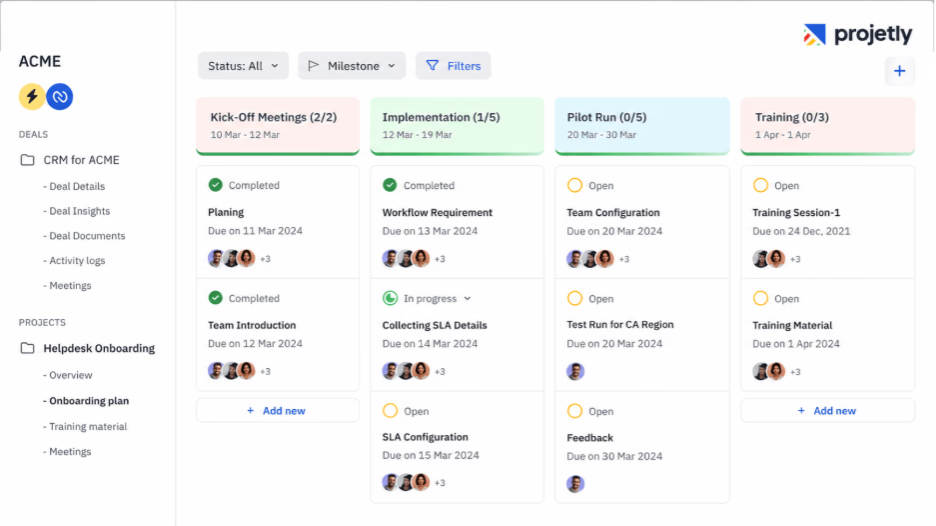
Projetly is built for enterprise B2B selling, where deal cycles are long and multiple stakeholders touch the deal over time. Its standout feature is lifecycle continuity: it eliminates the broken handoff between sales and customer success by preserving deal context as the workspace flips from a sales room into a post-sale onboarding hub the moment a deal closes.
Best For: Enterprise B2B teams that want one workspace to carry a deal from first sales call through onboarding and go-live, without re-briefing the customer success team from scratch.
Features:
- A dedicated Digital Sales Room created for every deal in the CRM, with buyer engagement tracking and deal intelligence built into a shared workspace
- Automatic transfer of proposals, documents, conversations, and engagement history into the onboarding project the moment a deal closes
- Meeting integrations (including Zoom) that generate AI summaries, meeting minutes, and action items reps can add to shared projects with one click
- Milestone tracking, Kanban boards, and checklist management for the post-sale implementation phase
Limitations:
- Reviewers note a learning curve for teams new to the combined sales-plus-onboarding workflow
Pricing: Projetly lists a Starter plan at $19 per user per month and a Growth plan at $49 per user per month on G2. Enterprise pricing is available on request.
2. FollowUp
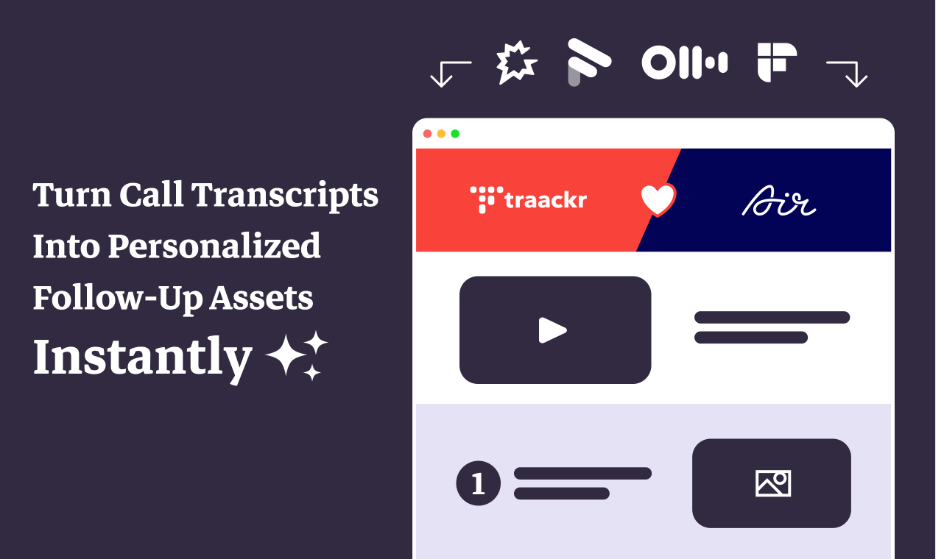
FollowUp is built around one core idea: the sales room should require zero setup. It generates the room automatically from the sales call recording, producing an instant recap and a resource hub that internal champions can use to sell the deal internally without waiting on the rep. It’s a strong fit for early-stage teams and founding AEs who need speed over configuration.
Best For: Founding AEs and lean early-stage startups who want a room generated automatically after every call, with no template-building or manual setup.
Features:
- Automatic room generation from the sales call recording, with a call recap and resource hub ready within minutes
- A shareable narrative package internal champions can use to sell the deal upward without extra work from the rep
- Startup-oriented pricing designed to scale with small teams rather than punish them for adding seats
Limitations:
- A newer, smaller product than most others on this list, with a narrower feature set focused on post-call recap and resourcing rather than a full deal-lifecycle platform
- Limited public G2 review history makes it harder to benchmark satisfaction against more established competitors
Pricing: FollowUp offers a free tier that generates one Digital Sales Room per day, with unlimited rooms available for $20 per user per month.
3. Trumpet
Trumpet leans hard into design. Its drag-and-drop “Pods” let reps assemble custom, co-branded microsites in minutes, with tight CRM syncing underneath the polish. For teams where visual presentation and brand consistency matter as much as function, Trumpet is usually the platform on the shortlist.
Best For: Revenue teams that want a highly polished, on-brand buyer experience alongside AI-driven engagement tracking and deal coaching.
Features:
- AI-generated deal resources such as executive summaries, content recommendations, and action items built automatically after each call
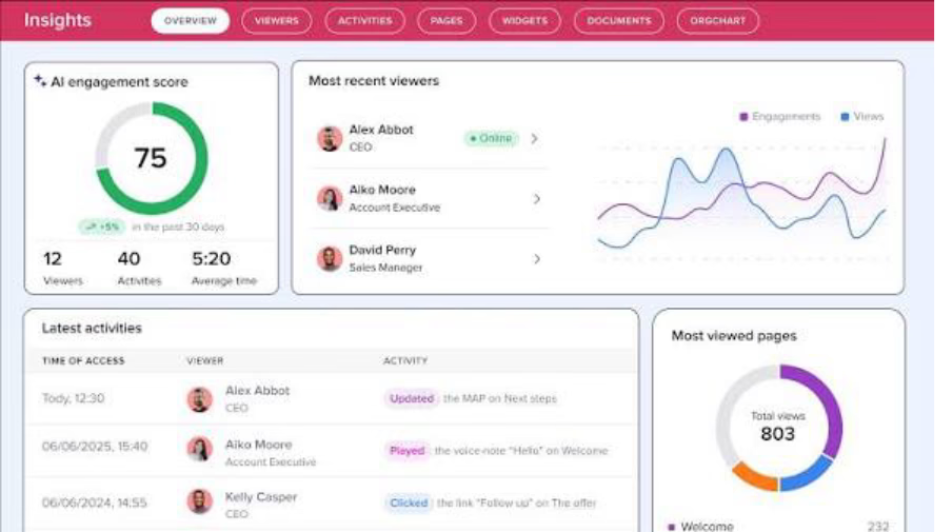
- Real-time engagement tracking showing exactly who is viewing what content and when, plus AI-driven deal-health scoring
- 35+ native integrations, including Salesforce, HubSpot, Gong, DocuSign, and Slack
- Reusable, brandable “Pod” templates and AI Auto Brand for fast, consistent room creation across a team
Limitations:
- Some users report a learning curve when getting comfortable with widget and room creation, and a number flag missing features that limit customization
- Users have pointed to layout issues, describing a clunky design and small document displays
- Integrations are only available on the higher-priced Scale and Elite tiers, so CRM syncing isn’t included at the entry price point
Pricing: Trumpet uses tiered per-user pricing: Free (10 sales rooms, unlimited users), Pro $45/user/month, Scale $100/user/month, and Elite $160/user/month (sales-assisted). Annual billing shown is $450/$1,000/$1,600 per user/year respectively.
4. GetAccept
GetAccept uses native AI to build personalized buyer portals informed by real-time context pulled from the deal. Beyond the room itself, it manages stakeholder alignment and contract workflows end to end, including native eSignatures, making it a popular choice for CRM-heavy, contract-driven sales motions, particularly those running on Microsoft Dynamics.
Best For: Sales teams whose process is contract-heavy and CRM-centric, especially those already standardized on Salesforce, HubSpot, or Microsoft Dynamics.
Features:
- AI that analyzes meetings, calls, emails, and CRM data to build and update personalized Digital Sales Rooms automatically
- Native e-signatures, proposal creation, and contract workflows built directly into the room
- Real-time buyer engagement tracking and deal intelligence surfaced as next-best-action guidance
- Native integrations with Salesforce, HubSpot, and Slack, plus 100+ additional connections
Limitations:
- Some reviewers note limited customization options, which has led to complications in contract management
- Others describe the editing process as clunky, particularly for complex documents
- Professional and Enterprise tiers require annual billing and a five-user minimum, which raises the effective entry cost above the advertised per-seat price
Pricing: The entry-level eSign plan starts at $25 per user per month, with the Professional tier priced at $49 per user per month (minimum five users, billed annually). Enterprise pricing is custom.
5. Dock
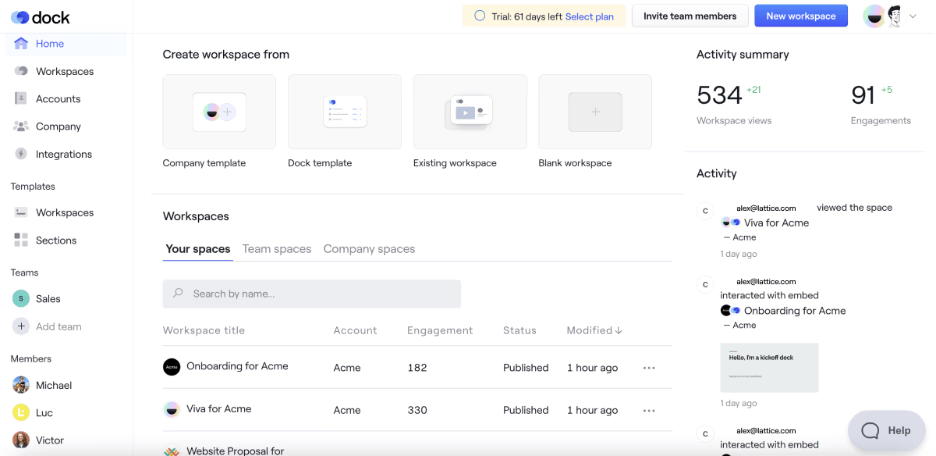
Dock’s focus is continuity rather than flash. It’s built to carry a closed-won deal smoothly into a client implementation portal, so the handoff from sales to onboarding doesn’t reset the relationship back to zero. Its mutual action plans include automated step dependencies and smart deadline reminders, making it especially strong for teams whose biggest bottleneck is post-sale, not pre-sale.
Best For: Mid-market SaaS teams managing multi-stakeholder deals who want digital sales rooms, client onboarding portals, and content management under one flat-rate platform rather than per-seat pricing.
Features:
- Digital sales rooms plus client onboarding portals in one connected workspace, so context carries from close to implementation
- An AI Enablement Agent that guides reps in real time, plus AI-generated personalized customer documents
- CRM integrations and automations for HubSpot and Salesforce
- A genuinely usable free tier for testing the platform at small scale before committing to a paid plan
Limitations:
- Users note limited customization options that affect layout flexibility, and some report missing functionality that requires manual workarounds
- Several reviewers describe integration issues, particularly when embedding tools or managing automations
- Pricing runs as a flat platform fee per tier rather than simple per-seat pricing, which can make cost comparisons less straightforward
Pricing: Dock offers a free plan covering up to 50 customer workspaces, with the Standard plan starting at $350 per month for five users, and the Premium plan priced at $1,000 per month (billed annually) for ten users. Enterprise pricing is available on request.
6. Aligned
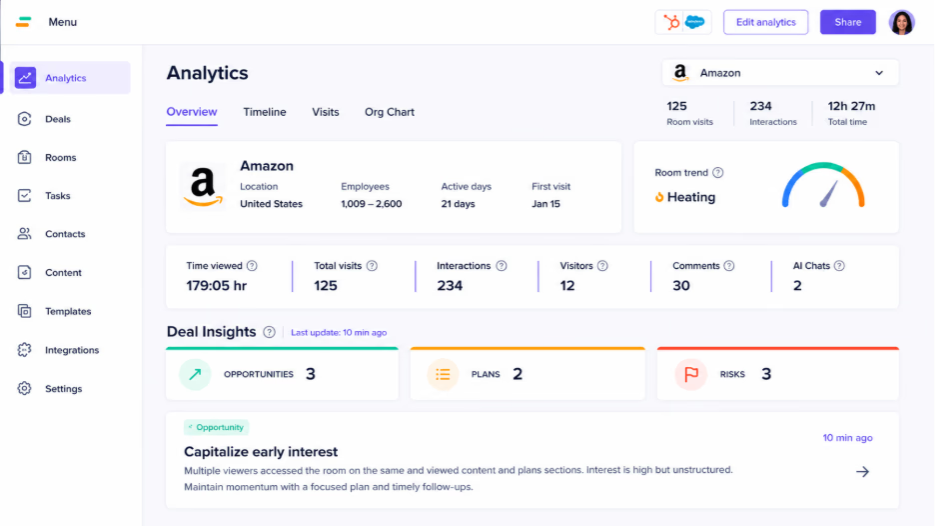
Aligned is built around deep buyer collaboration. Its emphasis on shared mutual action plans and joint deal execution reflects a broader shift in the category: away from the seller pushing a pitch, toward both sides jointly managing the path to close.
Best For: Revenue teams running complex, multi-stakeholder B2B deals who want a single AI-assisted workspace spanning pipeline creation through onboarding and expansion.
Features:
- AI that auto-builds deal resources after every call, including executive summaries, requested content, and action items, without manual prompting
- Automatic stakeholder mapping to surface hidden influencers and guide multithreading
- An embedded AI assistant buyers can use directly inside the workspace to get questions answered without waiting on the rep
- Shared onboarding and customer workspaces that extend the same room past close, into implementation and renewals
Limitations:
- Users report limited customization, especially around personalization options and org chart functionality
- Missing features are cited as limiting usability in some cases, and integration issues have come up around CRM compatibility
- Full value depends on consistent engagement from the buyer’s side. If buyers don’t log in, the collaborative features add less value
Pricing: Aligned offers a free-forever Starter plan, with paid tiers including a Basic plan around $29 to $35 per seat per month and a Pro plan around $60 per seat per month. Enterprise pricing is custom.
7. Flowla
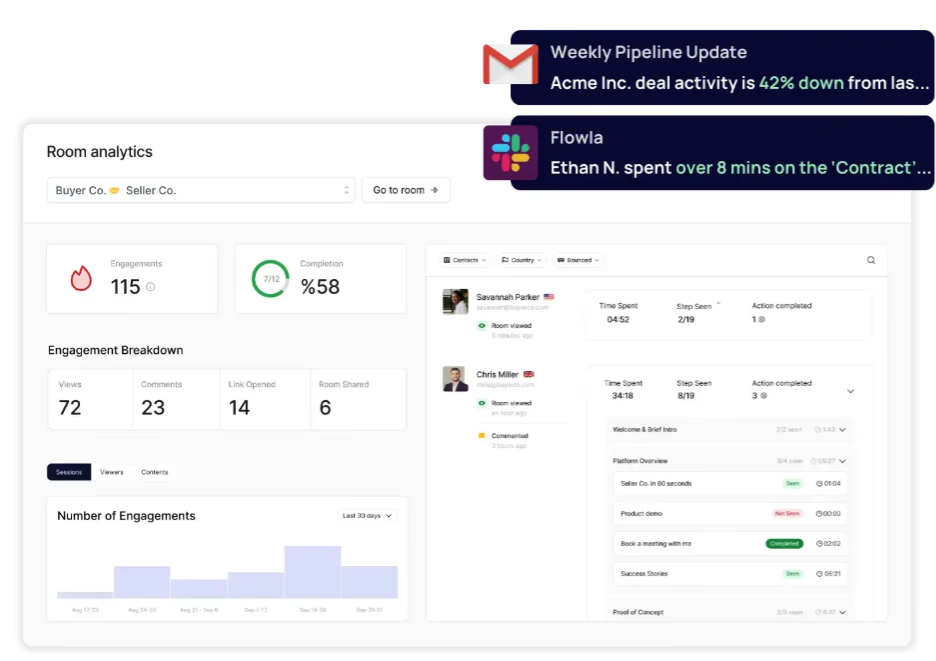
Flowla offers AI-generated room outlines, automatic stakeholder summaries, and clean, workflow-driven mutual action plans. It’s a good option for teams that want the structure and automation of an AI-native room without a steep setup curve.
Best For: Sales, RevOps, and Customer Success teams who want AI to handle room creation, CRM syncing, and stalled-deal follow-ups automatically across the full revenue motion, not just pre-signature.
Features:
- AI agents that automatically generate business cases, mutual action plans, and post-sale handoff briefs
- Automatic detection of new decision-makers entering a deal, with nudges to multithread early
- Auto-generated, contextual follow-ups triggered when a deal stalls or a buyer goes quiet, with a review queue so reps stay in control
- Unlimited deal rooms with per-seat pricing that only charges for room creators, not viewer-only teammates
Limitations:
- Some users find customization options lack flexibility, which can be a challenge for teams with strict brand guidelines
- A few reviewers note that admin settings can be difficult to navigate during initial setup
- Its G2 review base, while highly rated, is smaller than more established competitors like Trumpet or Aligned
Pricing: Flowla offers a free Starter plan with limited deal rooms, a Pro plan at $49 per user per month with unlimited deal rooms, and a Team plan at $79 per user per month that adds AI agents and automated workflows. Enterprise pricing is custom.
Honorable Mention: Mutiny
Worth a note even outside the top seven: Mutiny targets named-account enterprise motions and focuses on agentic generation of customer-facing content, including business cases and custom decks, built specifically for complex, multi-stakeholder deals.
Choosing the Right AI-Native DSR
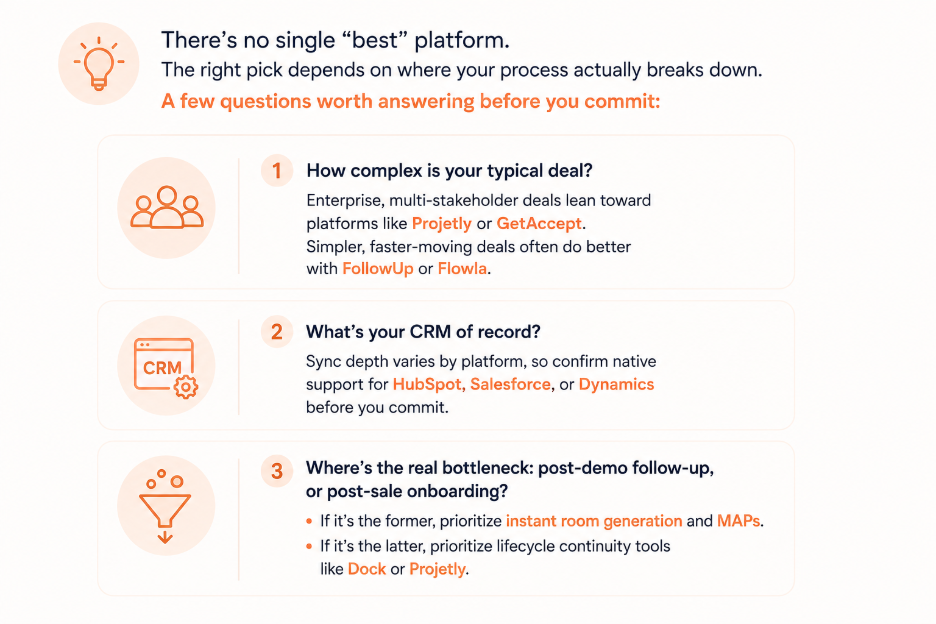
- How complex is your typical deal? Enterprise, multi-stakeholder deals lean toward platforms like Projetly or GetAccept. Simpler, faster-moving deals often do better with FollowUp or Flowla.
- What’s your CRM of record? Sync depth varies by platform, so confirm native support for HubSpot, Salesforce, or Dynamics before you commit.
- Where’s the real bottleneck: post-demo follow-up, or post-sale onboarding? If it’s the former, prioritize instant room generation and MAPs. If it’s the latter, prioritize lifecycle continuity tools like Dock or Projetly.
FAQ
- What’s the difference between a legacy digital sales room and an AI-native one?
A legacy DSR is essentially a smarter file-sharing link. A rep still has to manually build the page, upload the deck, and update milestones by hand. An AI-native DSR generates and updates itself: it listens to call recordings or reads CRM activity, automatically populates the room, flags new stakeholders, and drafts follow-ups without a rep opening a template.
- Which of these platforms is best for a small startup team?
FollowUp and Flowla tend to fit lean teams best. Both offer usable free tiers and per-seat pricing that scales gently as a team grows, without the five- or ten-seat minimums some enterprise-oriented tools carry.
- Which platform is best if my biggest bottleneck is post-sale onboarding, not pre-sale follow-up?
Projetly and Dock are the two built specifically around that handoff. Both carry a closed-won deal’s full context (documents, conversations, engagement history) directly into a customer onboarding workspace, rather than starting the customer success relationship from zero.
- Do these tools replace a CRM like Salesforce or HubSpot?
No. They sit on top of a CRM rather than replacing it. All seven platforms sync with major CRMs to pull deal data in and push engagement data back out. The DSR is the buyer-facing layer; the CRM remains the internal system of record.
- How much should I expect to pay for an AI-native DSR?
Pricing varies widely by model. Per-seat tools like GetAccept, Aligned, Trumpet, and Flowla generally start in the $20 to $60 per user per month range at the entry tier, climbing toward $80 to $125 per seat at the top tier. Dock is the outlier with flat platform pricing starting at $350 per month for five users. Most platforms offer a free or trial tier, so it’s worth testing the actual workflow before comparing sticker prices.
The Bigger Picture
The push toward an AI-native digital sales room in 2026 comes down to two things: compressing sales cycle time and giving teams real visibility into what’s happening inside a deal. Rather than buying into another sprawling sales suite, more organizations are opting for a focused, AI-native layer that sits directly on top of the CRM they already use, doing the administrative work automatically so reps can spend their time on the parts of the deal that actually need a human.

